
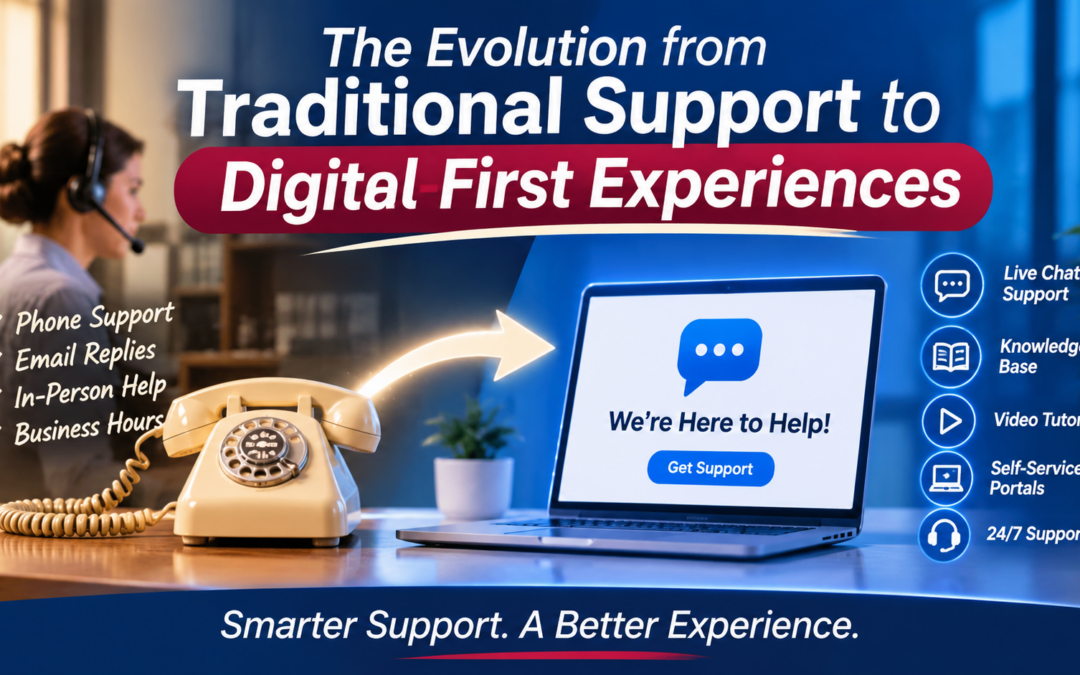
The Evolution from Traditional Support to Digital-First Experiences
Support has always been a cornerstone of business-to-customer relationships. From the earliest days of commerce, people have sought help with products, services, and technical challenges. What began as face-to-face conversations and telephones has transformed into a complex digital ecosystem that spans automated bots, AI assistants, omnichannel platforms, and user-driven self-service. In 2026, the narrative of customer support is no longer simply about fixing problems — it’s about delivering seamless experiences that reflect, anticipate, and elevate user expectations.
This blog explores how traditional support gave way to digital-first experiences, the forces that powered this transition, the technologies that define today’s support landscape, and what organizations must do to thrive in an increasingly digital world.
1. What Traditional Support Looked Like
Traditional support — the kind most people grew up with — was characterized by:
-
Face-to-face interactions — in stores, service centers, or office lobbies.
-
Telephone support — with call centers, switchboards, and waiting music.
-
Mail or fax-based communication — for requests and documentation.
-
Paper manuals or printed FAQs — to troubleshoot issues offline.
In this model, support was often reactive. A customer would encounter an issue and then seek out assistance — typically through a phone call or an in-person visit. Support agents relied on scripts, product manuals, and centralized knowledge banks to resolve issues. While this model served businesses for decades, it had key limitations:
-
Limited availability — support was constrained to business hours.
-
High cost per interaction — live agents are expensive.
-
Inconsistent quality — performance varied by agent skill and training.
-
Slow resolution — backlogs and wait times were commonplace.
Despite these drawbacks, traditional support had strengths: human interaction, empathy, and personalized attention when executed well. However, as digital technologies proliferated, customer behavior shifted faster than support models could adapt.
2. What Triggered the Shift Toward Digital-First Support
Several converging forces pushed support into the digital era:
A. Consumer Expectations Evolved
As the internet became integral to daily life, users expected instant access to information and solutions. Waiting on hold or tracking down a support location became increasingly unacceptable. Consumers wanted support that matched the speed and flexibility of the digital services they used — responsive, real-time, and available anytime.
B. Mobile and Social Platforms Changed Interaction Patterns
Smartphones, social media, and messaging apps shifted how people communicate. Customers began expecting help through the same channels they use socially — text, chat, and virtual assistants. Brands who didn’t adapt risked losing relevance.
C. Costs and Scalability Pressures Grew
Traditional support models, with their costly human-centric infrastructure, struggled to scale. As customer bases grew globally, businesses needed cost-effective models that could handle high volumes without compromising quality.
D. Data and Analytics Enabled Better Understanding
With digital interaction comes data — and organizations quickly realized the value of customer data for improving support quality, speed, and personalization. This ushered in an era of data-driven decision-making in support strategy.
3. The First Wave of Digital Support: Self-Service and Knowledge Bases
Early digital support focused on self-service:
-
FAQs became online staples.
-
Knowledge bases organized information by topic, product, and issue.
-
Searchable help centers provided instant access to content.
The appeal of self-service was obvious: customers could find answers quickly without contacting support staff, and businesses reduced ticket volume. However, early self-service had limitations:
-
Knowledge bases often lacked context sensitivity — users had to know what to search for.
-
Content could be outdated or inconsistent.
-
Users still needed to interpret solutions without guided support.
While a major step forward, early self-service was only the beginning. It laid the groundwork for digital-first experiences, but true transformation required deeper integration of technology and human-centric design.
4. Digital-First Experiences Defined
A digital-first support experience is one where digital channels lead the support strategy — not as an afterthought, but as the primary means of engagement. Key characteristics include:
A. Availability Across Digital Channels
Support isn’t confined to one platform. Users can get help through:
-
Websites and mobile apps
-
In-app messaging
-
Chatbots
-
Messaging platforms (e.g., WhatsApp, SMS)
-
Social media
-
Email
The goal isn’t just presence on these channels — it’s consistent experience, so users don’t have to repeat context when switching channels.
B. Seamless Integration of Tools and Interfaces
Digital-first support emphasizes interconnected systems:
-
Customer history and preferences travel with the user across channels.
-
AI and automation augment human capabilities.
-
Contextual data informs responses in real-time.
C. Personalization and Context Awareness
Support systems now tailor responses based on:
-
User identity and purchase history
-
Past support interactions
-
Current behavior in apps or websites
-
Real-time analytics and sentiment
This allows support to feel personal rather than transactional.
D. Proactive and Predictive Engagement
Instead of waiting for issues to surface, digital systems can:
-
Detect anomalies or errors before users notice
-
Notify users of issues and solutions preemptively
-
Anticipate questions based on behavior patterns
This marks a major shift from reactive to proactive support — an attribute central to digital-first experiences.
5. Technologies Powering Digital-First Support
Digital-first support wouldn’t be possible without a suite of enabling technologies. Here are the key drivers:
A. Artificial Intelligence and Machine Learning
AI enables systems to:
-
Understand natural language in customer queries (NLP/NLU)
-
Provide context-aware responses
-
Classify and route issues intelligently
-
Learn from interactions to improve over time
Machine learning ensures that support systems get smarter with usage — reducing repetitive tasks and enabling human agents to focus on high-impact interactions.
B. Conversational Interfaces
Chatbots, virtual assistants, and conversational UIs allow customers to engage in natural dialogue rather than rigid form-based interactions. These interfaces can:
-
Interpret intent even when users phrase questions in informal language
-
Guide users step-by-step
-
Escalate to humans when necessary
C. Omnichannel Platforms
Omnichannel support systems unify messaging across platforms. With this:
-
Conversations maintain continuity across channels
-
Support agents see the entire interaction history
-
Users avoid repeating themselves
This is particularly important as customers toggle between web, mobile, social, and messaging channels.
D. Digital Adoption Tools
Tools like in-app guidance and contextual overlays help users during their journey — before they even seek support. Instead of just answering questions, digital adoption tools prevent problems by offering assistance at the point of need.
6. From Reactive to Proactive: The Philosophy of Digital-First Support
One of the greatest distinctions between traditional and digital-first support is the shift toward proactivity.
Instead of waiting for a user to say, “Help, something’s wrong,” digital systems can:
-
Detect issues in real time
-
Predict common problems based on user behavior
-
Offer solutions before the user asks
-
Personalize guidance based on usage patterns
This shift isn’t just about technology; it’s a shift in philosophy — from reacting to issues to anticipating and avoiding them.
7. Personalization at Scale
In traditional support, personalization was limited to the empathy and skill of the agent. In digital-first support, personalization is systematic:
-
User context — where they are in the product, what they’ve tried already.
-
History and preferences — how they’ve interacted with support previously.
-
Behavioral insights — understanding intent and frustration through analytics.
With this intelligence, digital support systems can deliver:
-
Tailored solutions
-
Adaptive workflows
-
Intelligent routing to the best resource (bot or human)
-
Predictive guidance
This makes support feel human even when automated.
8. The Human and the Machine: A Collaborative Model
There’s sometimes a misconception that digital-first means human-less. It doesn’t. Rather, digital-first means the right activation of humans and machines in partnership:
-
AI handles routine interactions — freeing human agents to focus on complexity and empathy.
-
Human agents handle emotionally sensitive or uniquely complex issues.
-
Analytics assist human judgment — surfacing insights during live interactions.
-
Automation reduces administrative burden — boosting efficiency.
In this model, technology amplifies human potential rather than replacing it.
9. Impact on Business Outcomes
Digital-first support delivers measurable business value:
A. Improved Customer Satisfaction
Faster responses, personalized guidance, and seamless transitions across channels lead to higher satisfaction and loyalty.
B. Reduced Operational Costs
Automation and self-service reduce reliance on large call center teams while improving throughput.
C. Greater Customer Retention
Proactive support and faster resolution help retain customers and reduce churn.
D. Actionable Insights for Product Improvement
Support data becomes feedback loops into product development — helping teams fix issues at the source.
10. Challenges in the Digital-First Journey
Adopting digital-first isn’t without challenges:
A. Balancing Automation and Humanity
Too much reliance on automation can feel cold; too little limits scalability. The sweet spot requires thoughtful design and ongoing optimization.
B. Data Privacy and Security
Personalized support depends on data — which must be protected and compliant with privacy standards.
C. System Integration
Success requires unifying data across platforms — CRM, messaging tools, knowledge bases, analytics, and AI engines.
D. Change Management
Shifting from traditional support structures to digital-first models demands new skills, cultures, and workflows.
11. What the Future Holds
Looking forward, digital-first support will continue evolving along several key trends:
A. Even Smarter AI
AI agents will move from scripted responses to deeper reasoning, contextual empathy, and conversational memory.
B. Multimodal Support
Voice, visual assistance, augmented reality (AR), and immersive guidance will supplement text-based support.
C. Predictive, Not Just Reactive
Predictive analytics will power not just support but user success, minimizing friction across entire customer journeys.
D. Support Embedded in Products
Rather than existing as a separate function, support will be woven directly into user experiences — support as part of the product itself.
12. Conclusion: The Customer Experience Imperative
The evolution from traditional support to digital-first experiences is one of the most profound shifts in modern business. What once was a function relegated to call centers is now a strategic differentiator — a way companies express value, build trust, and deepen relationships.
Modern support is:
-
Customer-centric
-
Data-driven
-
Omnichannel-enabled
-
Intelligent and adaptive
-
Proactive and predictive
-
Collaborative between humans and machines
In 2026, organizations that excel in digital-first support don’t just resolve customer issues — they shape experiences that reinforce loyalty, drive retention, and distinguish brands in crowded markets. Support isn’t just a cost center anymore — it’s a source of competitive advantage and strategic growth. And as technologies continue to evolve, the organizations that stay curious, customer-obsessed, and innovative will lead the next wave of digital support transformation.
You can learn more about JDS WebDesign Support by clicking here.